The landscape I work from is both literal and internal.
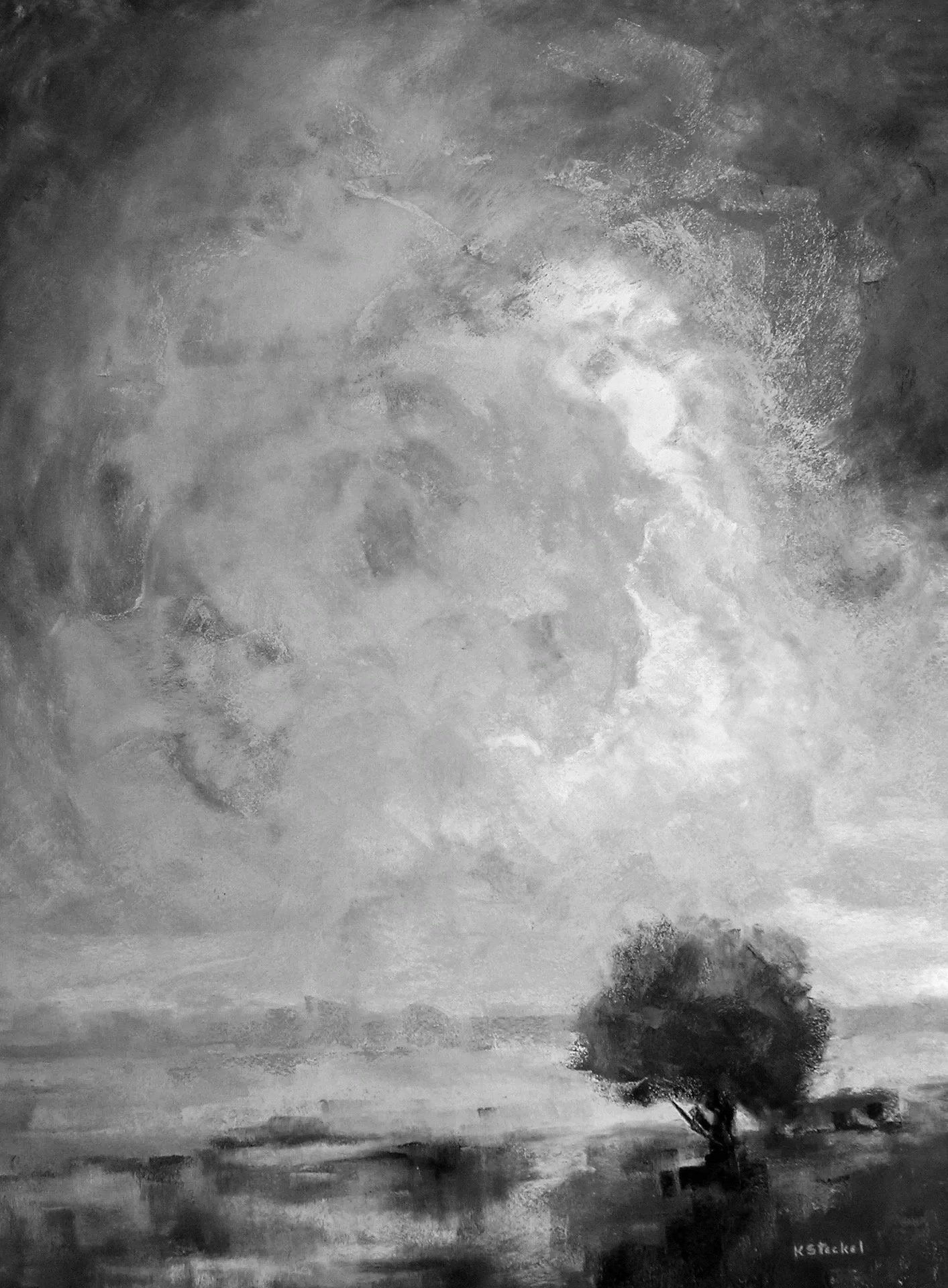
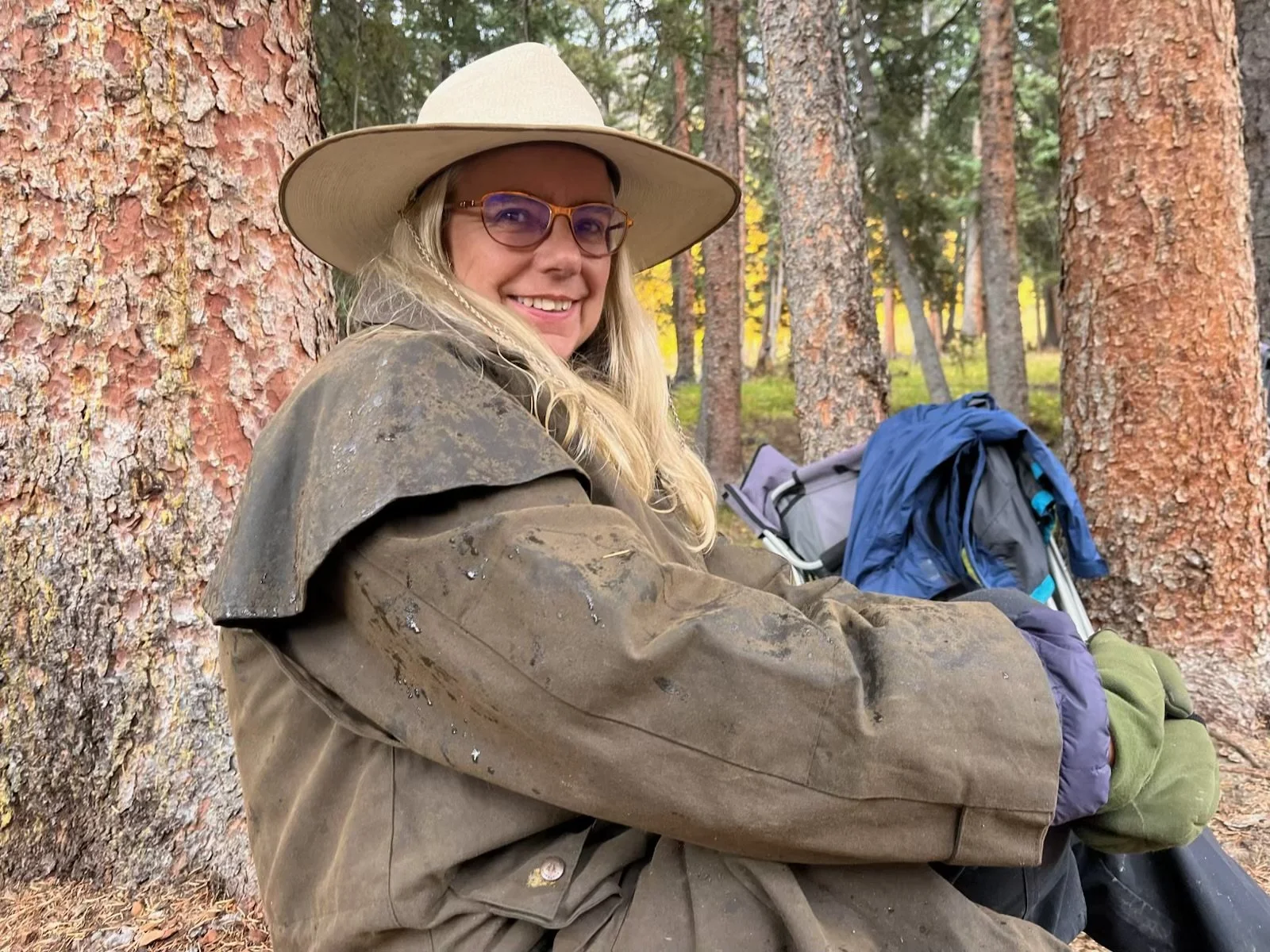
I enjoy painting outside — en plein air — absorbing color, light, and form directly. I cherish the time I can wander the high mountain landscapes of Colorado I have known since childhood, when my family left the city behind every chance we got — escaping to another world, the high country.
I grew up there among the old cabins, the aspen trees, playing in the cold mountain streams, fascinated by the tiny wildflowers above timberline. Those places are lodged in my very soul. What I carry back into the studio informs every decision: the color choices, the design, the form, the quality of light in a finished piece. The glass receives what the painting gathered — what I am carrying, what I am releasing, what reaches the light before I do.
I am fascinated by the concept of Notan drawings, the Japanese design principle that teaches harmony through the conversation between light and dark. I challenge myself to reduce a scene to four or five simple shapes in three or four values to make the composition strong — before a single color decision is made. This is the foundation I strive for beneath every piece of art I create. I am not painting things — I am painting the light that reveals them, and the shadows that gives them weight.
Glass and its love affair with light takes everything further. What I can suggest with paint, glass can transform — light moving through the work rather than bouncing off it, color alive from within. This is why I paint, and why I paint with glass.
For most of my career in art, I made technically demanding work for clients who needed it to succeed: Disney commissions, cathedral windows, public installations. I was good at it. But somewhere in the making, I had learned to ask permission — from the client, from the viewer, from a standard I had absorbed without questioning. It took time simply playing in my studio, and the challenge of a master teacher, to finally push open the door that had always been there. My earlier work asked permission to exist. My current work simply exists.
I did not intend to become a glass artist. I was halfway through a business degree when I understood, with the particular clarity of someone going in the wrong direction, that I was doing everything I was supposed to be doing — and feeding nothing that mattered. I found what I was looking for in Carbondale, Colorado, in Mary Matchell's glass studio. I never really left.
After two years with Mary, I left my native Colorado — bound for the wilds of Alaska to stake my claim to fame and fortune in glass. There I designed, fabricated, and installed stained glass windows for private homes, religious spaces, and public art commissions. Alaska also gave me my first encounter with glass fusing — a material so new to the scene that almost no one was working with it yet. That early curiosity eventually led me to Pilchuck Glass School in the mid-1980s, to study fusing formally with Klaus Moje.
Mary Matchell gave me the foundation — and, without knowing it, the direction of the rest of my life. Klaus Moje, at Pilchuck Glass School in 1986, showed me what was possible — that the only boundaries were the ones I brought with me. A year in Transjö, Sweden — in the heart of the Glass Kingdom — gave me something no formal training could: time to watch, to absorb, to study design at the hands of masters, and to build stained glass work for the artist Ann Warff. Narcissus Quagliata asked for something none of my previous work had required — accountability to myself rather than to a client.
Glass has given me so much — discipline and freedom both, supreme challenges alongside the grace of acceptance, and above all, joy — and everything it has given me, I want to pass on. My greatest gift now is to open that door for someone else. This is my legacy: passing everything I have learned to those who are ready to carry it further.
Today I walk into the studio for myself. No commissions, no deadlines, no juries — only joy. After decades of bringing technical mastery to other people's visions, I am finally bringing it to my own — and continue to explore what happens when painting and glass stop being separate practices and start speaking to each other. I am, quite simply, having the time of my life.
Crawford, Colorado sits in the North Fork Valley — high desert country nestled against the West Elk Wilderness, with the North Rim of the Black Canyon of the Gunnison just a few miles from town. We are on the West Elk Loop Scenic Byway, part of a state-certified Creative District that draws artists, musicians, farmers, and makers from across the region. The sage, the juniper, the light coming through the aspens after a gentle rain — all of it breathtaking, sacred, calming, grounding. This landscape has been here far longer than my mere existence, and will remain long after. All of it finds its way into the work — not always intentionally, but inevitably. The land doesn't ask permission either.
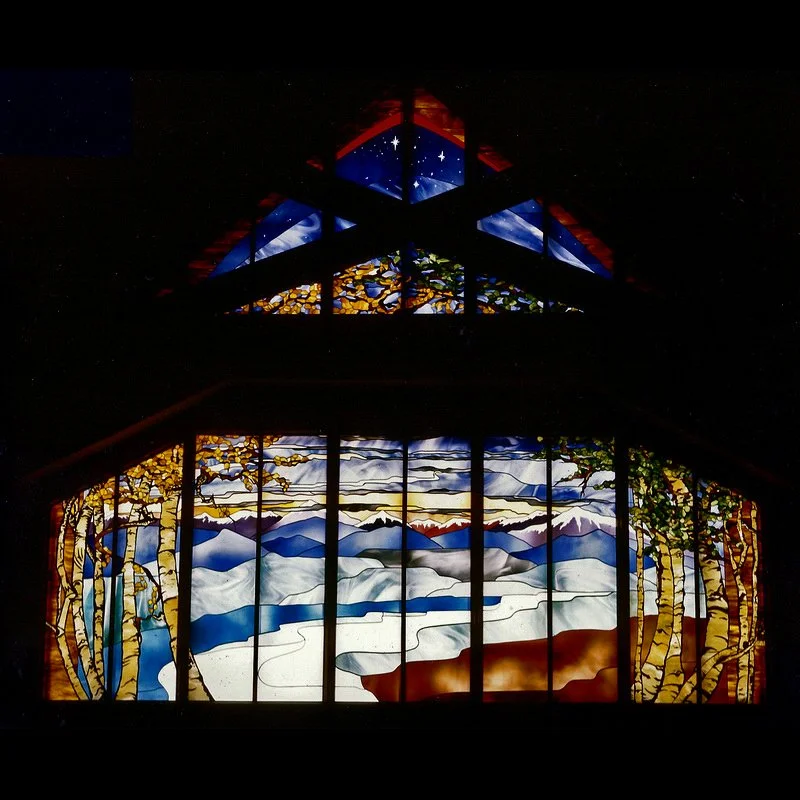
Major Commissions
Falconer Residence, Louisville, KY — fused glass entry doors, 7' x 8', 2008
Disney's Grand Californian Hotel, Anaheim — bent glass lanterns, 2000
Disney's Ambassador Hotel, Tokyo — large-scale blown glass vases, 2000
Good Shepherd Lutheran Church, Glenwood Springs, CO — stained glass window, 10' x 8', 1999
St. Michael's Catholic Church, Delta, CO — stained glass window, 30' x 16', 1996
Lutheran Church of Hope, Anchorage, AK — faceted glass window, 30' x 8', 1984
First Presbyterian Church, Anchorage, AK — stained glass window, 18' x 17', 1985
Chugiak High School, Anchorage, AK — fused glass wall mural, 1986
Chukchi Community College, Kotzebue, AK — stained glass window, 8' x 4', 1986
Exhibitions & Publications
Pastel 100, National Competition — 2nd Place, 2010
American Craft Council Juried Shows — 15 consecutive years, 1989–2004, Baltimore and West Springfield
Fabricator Magazine, May–June 1998
Colorado Homes and Lifestyles, October 1996
Architectural Digest, September 1994
Affiliations
SIGNATURE MEMBER (JURIED DESIGNATION)